5 Play-Based Activities for Raising Bilingual Children
Play Matters in Bilingual Language Development
Raising a bilingual child doesn't require expensive programs or perfectly planned lessons. In fact, children learn language best through meaningful interactions with the people they love. Small, everyday moments can make a big difference in your child's bilingual language development.
Here are five simple activities that encourage language learning while making it fun for the whole family.
1. Label Common Items Around the House
Place labels (ex: post it notes) on everyday objects like the door, table, chair, refrigerator, mirror, and window in both languages. Don't feel like you need to label everything at once.
Assign a color per language (ex: Spanish vocabulary is a blue post it or on a white paper with blue marker, English vocabulary is in yellow, Mandarin vocabulary is in pink). This provides an additional visual aid for learning.
2. Acting out the Same Book in Both Languages
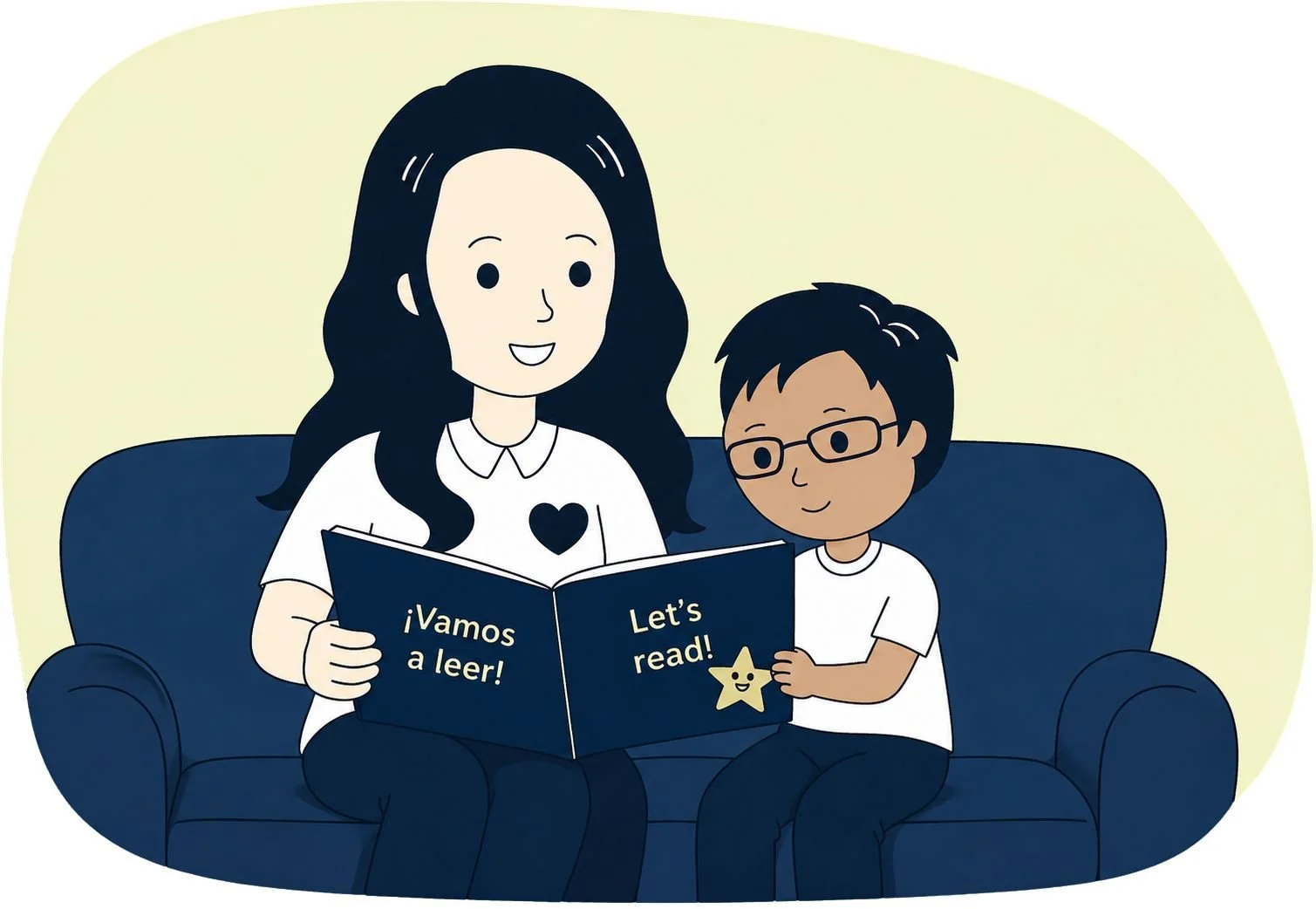
Choose a favorite story and read it in one language one day and the other language another day. You can make the experience more interactive by pausing during key moments and asking simple questions in the target language, or picking funny voices for the different characters. You can ask your child to repeat the target vocabulary word or phrase using the funny voice.
3. Create Theme Days
Try assigning one language to a particular structured activity per day (ex: cooking, grocery shopping, clean up time) instead of an entire day. You can switch the languages for the same activity on different days. This creates predictable opportunities to hear and use functional language.
4. Play "I Spy"
Describe colors, shapes, sizes, or locations in one language and let your child guess. As they become more confident, encourage them to take turns giving the clues.
5. Play-Based Photo Scavenger Hunt
You can keep it very simple or make it more structured depending on their age. Here are some scavenger hunt ideas:
Finding favorite things: “Take a picture of 5 toys you like.”
Find objects of a certain color: “Take a picture of 3 red things in the house.”
Find items by category: “Find 5 things you can eat,” or “Find 5 things you wear.”
Find items by function: “Take pictures of things we use to clean,” or “things we use to cook.”
Find objects in different locations: “Take a picture of something in the kitchen, bathroom, and bedroom.”
Find opposites or contrasts (for older children): “Find something big and something small,” or “something soft and something hard.”
Find action-based items: “Take a picture of something you can open, something you can close, and something you can turn on.”
Once your child has finished taking pictures, sit down together and go through them one by one. For each photo, name the object in the target language, and encourage your child to repeat or describe it if they are able. You can expand the activity by adding simple phrases such as:
“This is a chair.”
“I found a red ball.”
“We use this to eat.”
Celebrating the Joy of your Heritage Language
Language is more than vocabulary—it's culture, traditions, and connection.
Cook family recipes, celebrate cultural holidays, watch age-appropriate shows in both languages, and talk about your family's traditions. These experiences give children meaningful reasons to use both languages.
There isn't one perfect way to raise a bilingual child. The goal isn't perfection—it's consistent, joyful exposure to both languages.
If you have concerns about your child's speech or language development, remember that bilingualism itself does not cause speech delays. Hopefully this blog post can help answer some questions about “What is Normal in Bilingual Language Development.”
If you still have questions, please contact me. I would be honored to partner with you to support communication development and confidence at any stage of life. I provide multilingual speech therapy services in English, Mandarin Chinese, Spanish, and Portuguese for children, teens and adults. I can provide speech therapy services in your home in Leander, Cedar Park, or North Austin, or teletherapy in Texas. Please reach out if I could be of service to you.b